
I was recently having lunch with a customer who is early in his career as an information technology professional. We were meeting for the first time to discuss elements of his company’s business, his role in ensuring their business applications were always available, and how I could get him connected with the right technical expertise in my company. Upon examining the title from my business card, he asked,
“What exactly is technical sales?”.
I told him that I was responsible for the team of professionals who help him and his colleagues design and deploy solutions for their business based on my company’s technology. I have always thought that this was the most direct and complete description of the role. I also told him that our industry also often refers to the role as “sales engineering” or “pre-sales”, but the primary purpose of the role remains the same.
The exchange got me thinking about the mission of techincal sales professionals and how our role helps to drive business for our respective companies and business value for our customers. We work with customers in an often complex sales environment to understand their business and technology requirements, gain support amongst the customer stakeholders & project sponsors, and eliminate technical barriers that may be inhibiting the sale. Despite the occasionally maligned and often parodied nature of the sales profession as a whole, enterprise-class technology suppliers and their customers recognize the true value and innovation that trusted partnerships bring to their business.
The following graphic outlines the primary common and unique responsibilities of sales and technical sales professionals in an enterprise-class customer environment during a typical opportunity sales cycle.
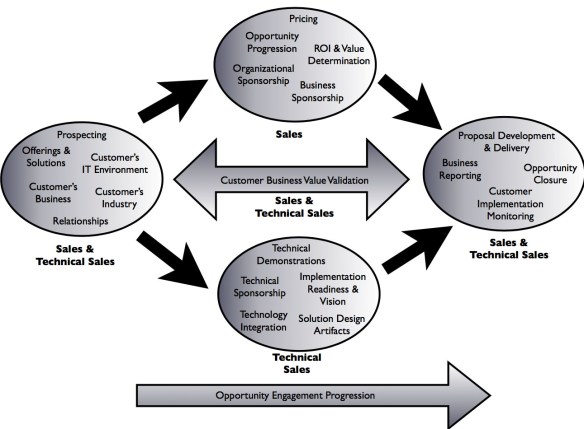
Progressing from left to right, both sales and technical sales professionals are responsible for the foundational aspects of customer relations, business development, and client satisfaction. This includes understanding the customers’ business, technology, and political environment, prospecting by looking for opportunities to contribute to the customers’ success, and building relationships. Ensuring that customers are successful with their existing investment in the provider’s solutions is critical as well.
As specific opportunities begin to develop, a division occurs in which the responsibilities for the sales professional focus on ensuring that the business requirements that are driving the customers’ investment in the technology are being met. This occurs by working with customers to determine the business value of the investment via a deeper exploration of the business needs and ensuring that the project stakeholders are in agreement. Similarly, the technical sales professional is focused on ensuring that customers are comfortable with the technical aspects of the solution. This occurs by working to determine how the solution meets the customer’s technical requirements, that the customer is prepared to implement the solution, and that it integrates seamlessly within their existing IT environment.
As the opportunity cycle approaches conclusion, the responsibilities converge once again to ensure that the appropriate proposals are developed and delivered to the customer, progression activities are reported back to the sales management team, and the opportunity is closed. During implementation, both roles are then responsible for ensuring that the customer is successful and, once again, the business value of their investment is constantly being realized.
Executing the sales function via a customer-focused model of shared responsibilities and teamwork such as this ensures optimal effectiveness of the sales organization and the satisfaction of customers. It demonstrates that both suppliers and their customers have a great deal to gain by a partnership-based relationship.
 Winning Technical Sales