
Hiring: Recruiting Methods

The recruiting of candidates for technical sales positions is best accomplished by combining both traditional “official” and unofficial methods. The traditional, corporate human resources led methods will leverage a company’s web site, external recruiters, and any internal or external job posting web sites that the company uses. The unofficial methods used by the hiring manager should include professional networking sites such as LinkedIn, the managers’ network of technology sales professionals both within and outside the company, and contacts and recommendations from customers. Althought the latter method is typically more effective in finding qualified candidates, combining the two will provide the broadest coverage and ensure the deepest pool.

The traditional methods mentioned above enable the gathering of candidates who are not already known by the hiring managers or the managers’ network. These methods can be effective, but often run the risk of excluding very qualified (and sometimes preferred) candidates because, although the recruiting organization is provided with all of the desired qualifications for the role, their evaluation of the candidates may be limited to resume searches for key terms. The fact that the recruiters may not be directly involved in the business for which they are recruiting also makes it challenging for them to discern truly qualified candidates. This is common in large organizations and underscores the need for well constructed job descriptions based on knowledge, skills, abilities, and other characteristics (KSAOs) resulting from analysis such as the approach recommended by Rosse & Levin in their “High Impact Hiring”. The unofficial recruiting method, driven directly by the hiring manager, can often be much more effective in not only getting qualified candidates in a more timely fashion, but getting candidates who are the right fit for the organization.

A recommended best practice for any manager is to always maintain a pool of contacts and candidates in case positions come available. This is often referred to as the “flow” method of recruiting and should be addressed as an element of succession planning. This is particularly true in technical sales, as very well qualified candidates typically come from former colleagues, customers, and “friends of friends”. These relationships enable the hiring manager to always have a few candidates in mind who understand the business and who may be looking to make a move. Customers can also be excellent sources of candidates and, if asked, will often provide names of individuals (some even from competitors) whom they enjoy working with and trust. Occasionally they will even recommend some of their current and former employees. The more trusted sources the hiring manager has for candidates, the better the candidate pool.
Book Review: “The Challenger Sale”

I recently “re-read” Matthew Dixon and Brent Adamson’s book, “The Challenger Sale: Taking Control of the Customer Conversation” via an Audiobook during a long drive to and from meetings with customers and employees. I found the refresher even more appropriate for how we are all looking to transform our businesses and the value we provide to our customers. The authors have developed a compelling case that sales professionals who are most effective at putting new ideas in front of their customers have been and will continue to be the most successful. They build their case by describing five types of sales reps, the names of which are self-explanatory:

  1. The Hard Worker
  2. The Challenger
  3. The Relationship Builder
  4. The Lone Wolf
  5. The Reactive Problem Solver

They cite much data from the recent economic downturn that demonstrates exactly how much more successful the “Challenger” sellers were in driving revenue for their companies and new solutions for their customers. And that word – solution – provides the key focus, as Challenger sellers are those who teach their customers about new ways of running their business and provide them with solutions to their business problems rather than mere products. Many will recall Lay, Hewlin, and Moore’s March 2009 article in the Harvard Business Review, “In a Downturn, Provoke Your Customers”, as proposing a similar approach to consultative selling.

How does this specifically apply to the technical sales profession and the manner in which technical sellers engage with their customers? This is particularly interesting to consider given that initially one might expect that the primary responsibility of many technical sales reps is to focus at the product level rather than on the larger solution. They are charged with having deep skills in a limited set of a supplier’s products, as they are the ones responsible for telling customers how the product works and how the customer can use it. The authors establish that a core behavior of the Challenger seller is that of a teacher. A Challenger seller provides insight and value that enables the customer to use the supplier’s offerings in new and innovative ways to run their business. With a solid foundation in the technical aspects of the products, the motivated technical sales professional should be able to raise their level of thinking and interaction with their customers to provide this sort of value. In a complex enterprise selling environment, this sort of behavior can become a true differentiator for a vendor.

Hiring: Business and Human Resources Strategy Alignment

Hiring the most effective sales engineers requires that many other elements be considered outside of mere technical skills with a company’s products and/or aptitude to acquire those skills. There is a balance that has to be found between depth of technical knowledge and the attributes of the best enterprise sales professionals. For example, the overall strategy of human resources must be aligned with the business strategy of the technology provider.

The competitive business strategies of enterprise IT providers typically focus on differentiation from the competition. By offering a variety of business technology solutions to customers, these professional sales organizations engage directly with their customers as both strategic trusted business advisors as well as technology industry leaders. Business value is provided to customers via a breadth of products as well as knowledge of how the technology is applied to those customers’ businesses.

To align with their competitive business strategy, the human resources strategy for enterprise IT providers must focus on the recruitment and retention of “committed experts”. Enterprise technology sales opportunities are by their very definition complex, which requires the sort of employee that can adapt to many types of often challenging customer situations. They involve selling advanced technology to address core business requirements into customer environments that typically already include substantial information technology investments. Sales cycles are often measured in multiple quarters and post-sale implementation support can become challenging if the customer is not fully prepared to take responsibility for implementing their investment. Therefore, the technology supplier requires adaptable employees who can dedicate themselves to the rigors of working in a rapidly changing technology field while also keeping up with changes in their customers’ business. These long-term employees develop long-term, profitable, symbiotic relationships with customers that lead to future sales and trusted expertise to drive value for the customer’s business. Low and non-performing employees are typically removed from the business after relatively short periods in order to avoid any long-term damage to customer relationships and to constantly encourage and reward high performance by all. HR policies and practices must be aligned to support this sort of technical sales professional.

The Mission of Technical Sales

I was recently having lunch with a customer who is early in his career as an information technology professional. We were meeting for the first time to discuss elements of his company’s business, his role in ensuring their business applications were always available, and how I could get him connected with the right technical expertise in my company. Upon examining the title from my business card, he asked,

“What exactly is technical sales?”.

I told him that I was responsible for the team of professionals who help him and his colleagues design and deploy solutions for their business based on my company’s technology. I have always thought that this was the most direct and complete description of the role. I also told him that our industry also often refers to the role as “sales engineering” or “pre-sales”, but the primary purpose of the role remains the same.

The exchange got me thinking about the mission of techincal sales professionals and how our role helps to drive business for our respective companies and business value for our customers. We work with customers in an often complex sales environment to understand their business and technology requirements, gain support amongst the customer stakeholders & project sponsors, and eliminate technical barriers that may be inhibiting the sale. Despite the occasionally maligned and often parodied nature of the sales profession as a whole, enterprise-class technology suppliers and their customers recognize the true value and innovation that trusted partnerships bring to their business.

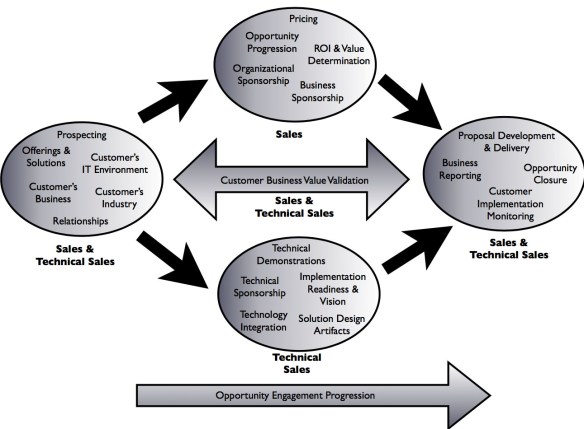
The following graphic outlines the primary common and unique responsibilities of sales and technical sales professionals in an enterprise-class customer environment during a typical opportunity sales cycle.

SalesTeamResponsibilities

Progressing from left to right, both sales and technical sales professionals are responsible for the foundational aspects of customer relations, business development, and client satisfaction. This includes understanding the customers’ business, technology, and political environment, prospecting by looking for opportunities to contribute to the customers’ success, and building relationships. Ensuring that customers are successful with their existing investment in the provider’s solutions is critical as well.

As specific opportunities begin to develop, a division occurs in which the responsibilities for the sales professional focus on ensuring that the business requirements that are driving the customers’ investment in the technology are being met. This occurs by working with customers to determine the business value of the investment via a deeper exploration of the business needs and ensuring that the project stakeholders are in agreement. Similarly, the technical sales professional is focused on ensuring that customers are comfortable with the technical aspects of the solution. This occurs by working to determine how the solution meets the customer’s technical requirements, that the customer is prepared to implement the solution, and that it integrates seamlessly within their existing IT environment.

As the opportunity cycle approaches conclusion, the responsibilities converge once again to ensure that the appropriate proposals are developed and delivered to the customer, progression activities are reported back to the sales management team, and the opportunity is closed. During implementation, both roles are then responsible for ensuring that the customer is successful and, once again, the business value of their investment is constantly being realized.

Executing the sales function via a customer-focused model of shared responsibilities and teamwork such as this ensures optimal effectiveness of the sales organization and the satisfaction of customers. It demonstrates that both suppliers and their customers have a great deal to gain by a partnership-based relationship.